By now it’s unnecessary to talk about the decline of the middle class in the United States. But just in case:
- The proportion of adults living in middle-class households has fallen from 61% in 1971 to 50% in 2021. Between 1967 and 2023, the percentage of families with incomes between $50,000 and $150,000 (in 2023 inflation-adjusted dollars) decreased from 56% to 47%.
- Middle-class Americans still represent the largest income group by sheer number, but they control a smaller portion of the nation’s total income. Thanks to billionaires.
- Since the 1970s, middle-class wages have stagnated. Not sure if you noticed, but housing, healthcare, and education have not. I don’t care that “TVs are so cheap now!” Things people need are not. Stagnation, by the way, is one way large organizations can “cut” their expenses or metrics without actually doing anything. Just leave it alone and over time it’s basically a big cut.
- To say nothing of other wealth distribution matters.
The Federal Reserve lets you modify custom charts. The blue line is what you hear about all the time: “Look how much more money people earn now!” All of this is inflation adjusted.
The red line is real median personal income, not household income. And The green dashed line is real disposable personal income. Again, not household income. The blue line is basically, “Look what you get if you cobble everyone together and split the rent.”
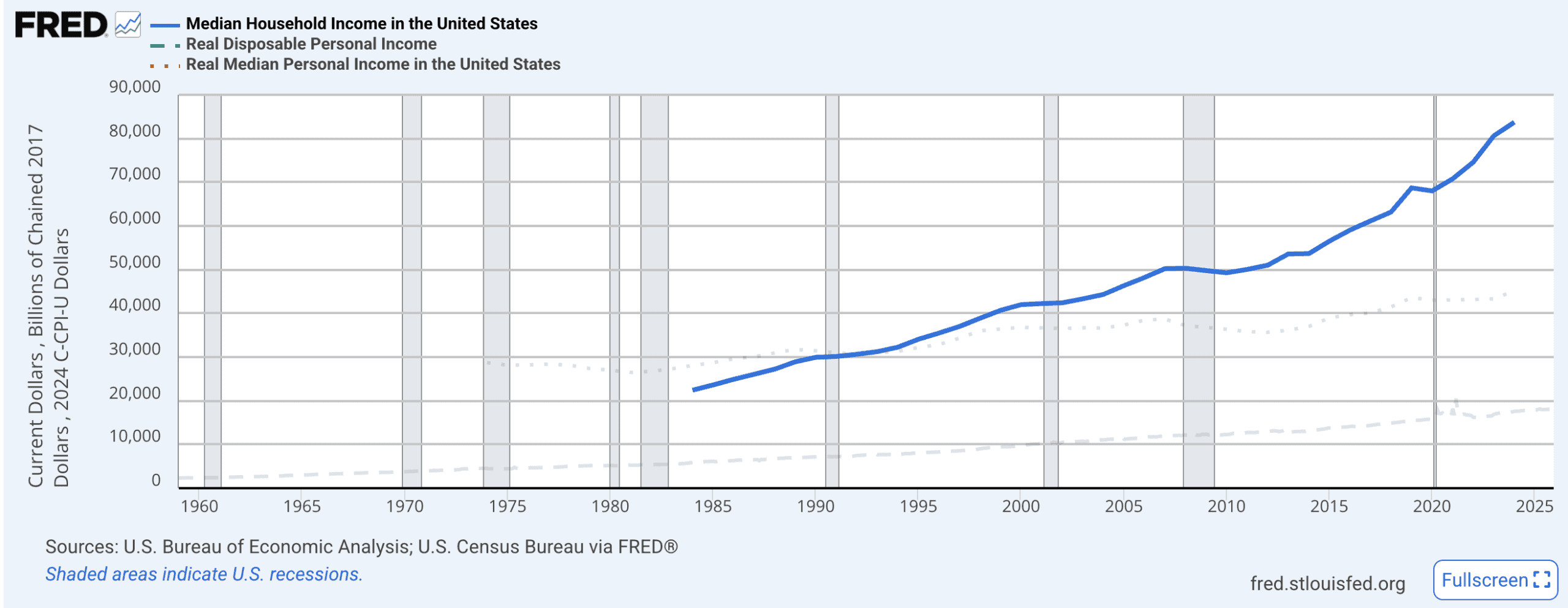
You can argue that getting married is clearly a ticket to financial independence. It’s usually been that way. And that numbers are alluring when at least part or one some of the graph goes up. Let us not forget that in America, “Number go up” might as well replace E Pluribus Unum on the seal. But that’s not what I’m here to talk about.
As people throw themselves at AI, we must wrestle with a hard truth that mirrors the economic reality of the United States in the last 60 years:
- Low-income, low-information, low-experience, lower-class (whatever you want to call them) people will remain there. They really had nowhere else to go.
- The upper-income, highly educated, highly-networked, highly-experienced upper class will be more than fine.
- The middle class of creative and technical people will contract, decline, and bear the brunt of the impact.
I make no illusion that I am in this middle class of creative professionals. I am not highly networked or connected with the billionaires and millionaires who run the economy. I am a nobody. I know, because if I died, almost no one would much notice or care. None of the work I have produced will outlast me or, for the most part, be of much value in even a few years. Nominally, the work I do for my students will outlive me only as long as they are alive. But I also recognize most of them openly do not care about the things I care about. That’s okay, but as any teacher will tell you, it’s quite numbing to talk to people every day you know are actively trying to do the least possible.
I also make no illusion that I am among the top 1% of anything. I’m not even in the top 10% of anything. I know because my bank account reflects that. And no, I do not want to be told “Yes, but compared to the rest of the world you’re rich.” This has all the same reckless thinking as “There are starving people in Africa, so eat your peas.” As if those peas would have been in Africa if not for me, right here, right now. These are wildly different problem sets, each with their own demands and circumstances.
If all this weren’t the case, I’d have industry-leading people and highly-connected, highly-influential people knocking on my door. I do not. This is how I know my work is not that influential or valuable.
Further, I know all of this continues to be true because the people I routinely interact with consistently show up with, “I made this with AI” and “I made this in Canva” (based on a template with some text overwritten in text boxes. This generation’s WordArt.) both of which are as offensive to me as telling a chef at her restaurant, “I made this sauce” as you pull some A1 out of your purse.
When my dad was newly unemployed after the closure of the lone factory in town, itself a remarkable vestige of an earlier era long since past, he remarked, “I wish computers had never been invented.” The line struck me as odd, as if a computer had taken his job at a factory that manufactured baby furniture away.
I think about that line a lot lately as we designers, writers, creatives, and developers sorta look around and wait for what may come to wash over us. I don’t find myself thinking “I wish AI had never been invented.” That would be a weird place to direct my ire. Instead, we, like my father, should probably have directed more ire at the people making decisions, policies, and services that led to the downfall of a way of life that has never recovered.
My dad could have been more irritated with NAFTA and other government leaders. We, in 2026, should probably be more irritated with the government-by-corporation we find ourselves in, where seven companies collectively hold up the entire economy. If you remove the top 7 companies in the US, our economic “growth” is more in line with Myanmar. We are, in truth, in a decline by as much as 1.2 this year. The Great Recession was a contraction of about 4.2%.
I am, instead, more irritated at cultural forces I have been powerless to impact, no matter who or what or how I vote, write, or live. I can’t even figure out what to do with glass bottles short of throwing them in a landfill.
I am irritated at the cultural forces that, morals be damned, push everyone en masse to favor the cheapest, fastest, good enough thing. I am exhausted by “good enough”. I have so little respect for “thought leaders” who push for “80%, ship it and let’s make money!” Some of this explains why creatives and tech professionals (to name one group) increasingly despise the economic forces enshittifying everything. We are just the next group in line. Just ask farmers how they feel about their million-dollar machinery they can’t afford but seemingly have to have “to keep up”.
I suspect I speak for a lot of people when I say: “I am tired of ‘keeping up’.” And I am further irritated that I, like probably the three people reading this post that haven’t resorted to an AI summary because they are “so busy”, I am incapable of doing anything to change anything. It’s not like I can just say, “Well, I guess I’ll become the nation’s leading expert in AI models” any more than you can decide to win Olympic gold next year while also affording food .There is no universe where everyone can simply be “the top 1%” of everything or anything.
There are people who are excited by waves around whatever is happening and I assure you I am not. I don’t get excited about much. All I see is a country full of people who are clinging to consumption, a “lifestyle”, and distraction-as-leisure by their fingertips.
It seems to me that further compounding all this frustration is how exposed I feel. There were generations of my ancestors who would have looked at what they needed at any point in time and just made or produced it themselves. They’d have probably felt proud, too. If they needed to eat, they would grow vegetables and hunt. If they needed a table, they would have fashioned one from the wood lot behind them. And, in a more equitable alternative past, this would have been true of nearly any ancestry regardless of race. Only in modern times do we wince at this thinking, “Yes, but where’s my TikTok time and air conditioning? How would I afford to drive the 20 miles to work?” We become accustomed to things very easily. What a weird evolutionary quirk.
Having the kind of resilient life that sustained a person or household, to me, seems like real wealth. The kind of wealth Thomas Jefferson advocated for. The ability for a person or household to have the kind of F.U. response to global forces that we lack today. Today, our entire economic force is predicated on everyone having “a job”, and if that job is lost, then “a new job” should be made available elsewhere within about 20 miles for you to slot into. Just as those coal miners so obviously became the coders of our modern era. I’m sure that’s working out well for them. (There’s probably a quip in here about coal miners being a canary in some digital mine.)
We in the middle class find ourselves in a situation where we can explain how to produce a multi-platform, cross-channel marketing campaign for perfume manufactured from the glands of a rare clone of a cell from an Amazonian tree frog to be sold on Amazon, all from a phone while standing in the actual Amazon. But we can’t grow a potato.
This does not seem like economic “progress” for anyone but a tiny few. This is, at best, an illusion of “growth”, all produced at the expense of our real, true wealth.
That’s why I’m not mad at the AI, per se. I am irritated at myself. I’m displeased with the forces that led us here and our collective inability to prevent it. And I’m fearful more or less of the lack of inherent resilience I seemingly have toward everything that seems engineered to completely roll over everything on a whim.